
Moving to the Roanoke Area: Complete Relocation Guide to Neighborhoods, Costs, and Lifestyle
Relocating to the Roanoke area means landing in one of Virginia's most livable valleys, where housing costs run well below the state's urban corridors, mountain trails begin within minutes of most front doors, and the average commute sits around 19 minutes (U.S. Census Bureau, 2020–2024 ACS). Whether your priority is school districts, career opportunities, neighborhood character, or outdoor access, this guide covers the practical ground so you can make your move with confidence.
What Makes the Roanoke Area Worth the Move?
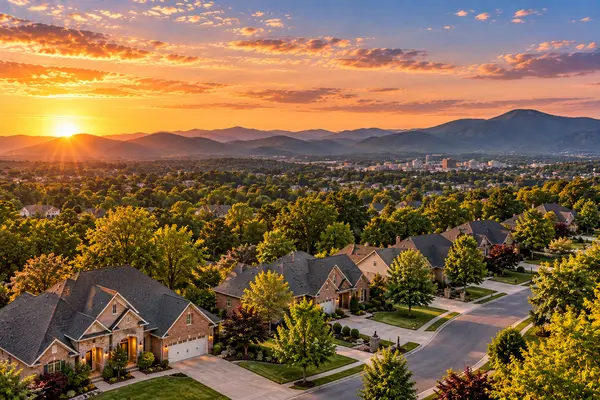
Roanoke's most consistent draw for relocators is the gap between what you get and what you pay: lower housing costs, short commutes, and immediate mountain access, at a fraction of what Northern Virginia or Richmond charge. The region is the largest metropolitan area in western Virginia, serving a combined population of roughly 330,000 across the valley (Virginia Economic Development Partnership, 2024 estimates). At its center is Roanoke City, with an estimated 99,111 residents as of July 2025 (U.S. Census Bureau, V2025). Surrounding it are communities like Roanoke County, Cave Spring, Hidden Valley, Bonsack, and the city's established in-town neighborhoods.
Housing is significantly more affordable than Northern Virginia, Richmond, or coastal markets. Daily commutes are short. Blue Ridge Mountain access is immediate. And the city has enough cultural and culinary life to keep most households engaged without needing to drive two hours.
The iconic Roanoke Star, an 88.5-foot illuminated landmark perched on Mill Mountain, looks down over a valley that rewards people who slow down and put down roots.
Roanoke Area Housing Market: What to Expect
The Roanoke area is not a single market. It is a collection of distinct submarkets, and understanding which one fits your priorities is the most important pre-move research you can do.
The table below shows the key metrics for the two primary submarkets as of early 2026, based on aggregated MLS listing data (three months ending March 2026):
| Submarket | Median Sale Price (Mar 2026) | Months of Supply | Median Days on Market |
|---|---|---|---|
| Roanoke City | ~$200,000 | Moderate | ~30 days |
| Roanoke County | ~$269,500 | ~1.3 months | ~29 days |
Roanoke City tends to carry the area's most accessible entry-level pricing, with more room for negotiation in most segments. Roanoke County is the tighter, more competitive suburban market. Buyers in Cave Spring, Hidden Valley, and Bonsack are moving quickly; overpriced listings or slow financing can cost you the house.
For a broader price-trend reference: Roanoke market's year-to-date median sale price for January through March 2025 was $293,475, up 6.4% from $274,750 in the same period a year prior. Virginia as a whole show continued year-over-year appreciation through the first quarter of 2026, consistent with a market that has moderated to a slower but steady pace of growth.
For buyers relocating from higher-cost Virginia markets, the pricing gap remains meaningful. Northern Virginia's year-to-date median for the same early-2025 period was $664,000, more than double the Roanoke figure.
Current Roanoke area listings are searchable by neighborhood and price tier, which can help calibrate expectations before you tour. The Roanoke area market snapshot provides a concise data overview by submarket if you want a quick read before you start visiting properties.
Neighborhoods and Communities: Finding Your Fit
The Roanoke area's neighborhoods each carry a distinct personality. Here is a working overview of the communities most commonly on relocators' radar.
Roanoke City: In-Town Neighborhoods
Grandin Court and Raleigh Court anchor one of the city's most recognizable in-town identities. Early 20th-century Craftsman bungalows and Cape Cods line tree-shaded streets within walking distance of the Grandin Theatre, independent coffee shops, and local restaurants. The neighborhood has a small-town-within-a-city feel that keeps long-term residents loyal. Walkability here is genuine, not aspirational.
Wasena sits along the Roanoke River and draws residents who want outdoor access stitched directly into daily life. The neighborhood connects to the Roanoke River Greenway, Wasena Park, and trail links toward Carvins Cove. Housing includes bungalows, duplexes, and smaller apartment buildings, creating a diverse mix of price points and residents.
Crystal Spring is closely associated with South Roanoke and appeals strongly to medical professionals because of its proximity to Carilion Clinic. Large, older homes with shaded yards line the streets, and the small Crystal Spring commercial cluster provides a neighborhood-scale daily routine. River's Edge Park and greenway access are nearby.
Roanoke County Communities
Cave Spring is a top draw for families. The area sits within Roanoke County and is served by a cluster of well-regarded public schools: Cave Spring Elementary, Cave Spring Middle, Cave Spring High School, Hidden Valley Middle, and Hidden Valley High School. Enrollment across these schools remains under maximum capacity as of the 2025–2026 school year, which means the district has room to absorb incoming families without significant pressure on resources. The mix of established subdivisions and newer construction gives buyers a range of options across mid-range and upper-tier price points.
Hidden Valley shares the southwest Roanoke County corridor with Cave Spring and draws families for many of the same reasons. The character is suburban with curving streets, established tree canopy, and strong neighborhood continuity. Proximity to Hidden Valley Country Club adds to the area's appeal for buyers seeking a settled, spacious lifestyle.
Bonsack sits in east Roanoke County and is one of the faster-growing communities in the region. It blends historic character with newer development and tends to attract buyers who want competitive pricing, solid commute access to Roanoke City employment centers, and a bit more space than the tighter southwestern neighborhoods offer.
The home buying process guide walks through each stage from pre-approval to closing, which is useful context before you start narrowing down neighborhoods.
Jobs and the Local Economy
Carilion Clinic is the region's dominant employer, with more than 10,000 jobs, and its economic footprint extends well beyond direct employment. Healthcare and social assistance collectively represent 18.5% of regional employment, the largest single sector. Manufacturing follows at 10.4%, anchored by companies including Altec Industries, Virginia Transformer, Mack Trucks, and Yokohama Tire Corp. Banking and financial services, logistics, and retail round out the broader employer base.
Roanoke County Economic Development reported more than $40 million in new capital investment and over 400 new jobs generated during 2025, including 20-plus new business locations and expansions (Roanoke County Economic Development, April 2026). The region's labor market is stable rather than rapidly expanding: Roanoke metro nonfarm payrolls were down 0.2% year over year in April 2026, with construction up 1.0% and education and health services up 1.6% (U.S. Bureau of Labor Statistics, April 2026).
For relocators moving to take a specific position at Carilion, Roanoke College, or a regional manufacturer, the job-market picture is steady and diverse. For those moving speculatively and planning to find work on arrival, healthcare, services, and manufacturing offer the broadest entry points.
Cost of Living: The Honest Picture
Roanoke's cost of living consistently ranks below the national average across most major categories, with housing representing the most significant gap. Relocators arriving from Northern Virginia, Richmond, or coastal mid-Atlantic markets typically find that the same budget goes meaningfully further here, both at the purchase stage and month to month.
Property taxes are a practical detail that often surprises relocators. The table below shows the two rates that matter most in the Roanoke area:
| Tax | Roanoke County | Roanoke City |
|---|---|---|
| Real estate (per $100 assessed value) | $1.03 | $1.22 |
| Personal property on vehicles (per $100) | $3.40 | $3.45 |
Rates are for calendar year 2026 (Roanoke County, VA, and City of Roanoke, VA, official tax rate tables). Virginia cities and counties are separate taxing jurisdictions, so the rate that applies to you depends on which side of that boundary your address falls on.
Virginia's state income tax runs on a graduated scale from 2% to 5.75%, topping out at 5.75% on taxable income above $17,000 (Virginia Department of Taxation). Virginia's combined sales tax rate in Roanoke is 5.3%, composed of a 4.3% state rate and a 1% mandatory local add-on.
For most households relocating from the mid-Atlantic or Northeast, the combination of lower housing costs, competitive property taxes, and a short commute means the dollar stretches noticeably further here than in their origin market.
Outdoor Life and Recreation
Outdoor access in the Roanoke area is a daily reality, not a selling point. Within 30 minutes of most Roanoke neighborhoods, residents can reach McAfee Knob on the Appalachian Trail, the Blue Ridge Parkway, Carvins Cove mountain bike trails, and Explore Park along the Roanoke River, four distinct outdoor destinations that cover hiking, cycling, paddling, and ridge-top views.
The Roanoke River Greenway is being developed as a continuous 25-mile trail running through Roanoke County, Roanoke City, the city of Salem, and the town of Vinton, which is adjacent to Roanoke County. A 1.4-mile section through Explore Park, connecting to Rutrough Point, was completed in December 2025 (Roanoke County, VA, official project page). The broader network ties neighborhoods to parks, the river, and trailheads in a way that makes outdoor activity genuinely routine rather than a special-occasion event.
The Blue Ridge Parkway enters the city's geography directly, with Mill Mountain and its surrounding park offering accessible ridge-top hiking within city limits. McAfee Knob is the most-photographed point on the Appalachian Trail, and neighboring Tinker Cliffs extends the same ridgeline into a full day's outing. The George Washington and Jefferson National Forests provide year-round hunting, fishing, mountain biking, and backcountry access.
Climate and Seasons
Roanoke experiences four distinct seasons, moderated by the valley's geography and the surrounding ridgelines. Visit Roanoke VA reports an average annual high of 67.2°F, an average annual low of 45.4°F, annual rainfall of 40.3 inches, and average annual snowfall of approximately 22.8 inches. Winters are mild relative to higher-elevation mountain communities. Significant accumulations on the valley floor are relatively rare, though nearby ridges pick up more.
Spring arrives with reliable color along the Parkway. Summers are warm and humid but not extreme by mid-Atlantic standards. Fall foliage across the Blue Ridge typically peaks from late September through early November. For outdoor-oriented relocators, the seasonal variety is generally considered one of the area's assets rather than a drawback.
Schools and Higher Education
Roanoke County Public Schools serves Cave Spring, Hidden Valley, Bonsack, and other county communities. Cave Spring High School and Hidden Valley High School are the two main county high school options in the southwest and central county areas. Enrollment across Cave Spring area schools remains under maximum capacity as of the 2025–2026 school year, which means the district has room for incoming families without significant pressure on existing resources.
Roanoke City Public Schools serves the city's in-town neighborhoods, including Grandin Court, Raleigh Court, Wasena, and Crystal Spring.
For higher education, the region includes Roanoke College in Salem, immediately adjacent to the city, Virginia Western Community College, and the Virginia Tech Carilion School of Medicine and Research Institute, which reflects the region's sustained investment in healthcare education and life sciences.
Getting Around
Roanoke is a driving city. Interstate 581 cuts through the valley and connects to I-81, which provides north-south regional access and links to Roanoke-Blacksburg Regional Airport. The mean travel time to work for Roanoke City residents is approximately 19 minutes (U.S. Census Bureau, 2020–2024 ACS). Residents in Cave Spring, Hidden Valley, and Bonsack typically reach Roanoke City employment centers in under 25 minutes under normal conditions.
Public transit exists through Valley Metro bus service, though the region's layout generally favors personal vehicles for most daily trips. Remote workers relocating to the area often find the commute question largely irrelevant to their neighborhood selection, which opens up the full geographic range of the valley.
Before You Move: A Practical Checklist
A few things worth addressing before the moving truck arrives:
- Identify your school district early. County and city lines matter for school assignments, and Cave Spring versus Hidden Valley enrollment boundaries have separate impacts on which schools your children will attend.
- Understand the city vs. county tax structure. Roanoke City and Roanoke County are separate tax jurisdictions with different rates. This affects both your real estate tax and your vehicle registration.
- Factor in the Virginia car tax. Personal property tax on vehicles is a real annual cost in Virginia that many out-of-state relocators do not anticipate. Roanoke County's rate is $3.40 per $100 of assessed value for 2026; Roanoke City's is $3.45 per $100 (official tax rate tables, calendar year 2026).
- Time your home search for the county. Cave Spring and Hidden Valley move fast. Homes in that corridor were selling in roughly 29 days in early 2026 (aggregated MLS listing data, three months ending March 2026). Arriving pre-approved matters in that submarket. The home buying process guide covers what pre-approval involves and what to expect at each stage.
- Run your numbers before you tour. The affordability calculator and mortgage calculator can help you pressure-test a budget before you start looking at homes in earnest.
Frequently Asked Questions
Is the Roanoke area affordable compared to the rest of Virginia?
Yes, by a wide margin in most categories. Roanoke year-to-date median sale price at $293,475 for January through March 2025, while Northern Virginia's figure for the same period stood at $664,000, more than double. Across other cost categories, Roanoke ranks consistently below the national average, with housing accounting for the largest share of that gap.
What neighborhoods in the Roanoke area are best for families?
Cave Spring and Hidden Valley, both in Roanoke County, lead most family-focused conversations about the area. Both offer access to Roanoke County Public Schools, including Cave Spring High and Hidden Valley High, with area schools currently under maximum enrollment capacity as of the 2025–2026 school year. Bonsack provides comparable county school access with more space and slightly more competitive pricing. In the city, Grandin Court and Raleigh Court appeal to families who put a premium on walkable neighborhood character. A full look at buyer resources for the Roanoke area is available if you want to dig deeper into the search process.
How competitive is the Roanoke County real estate market right now?
Supply near 1.3 months and a median of roughly 29 days on market in early 2026 (aggregated MLS listing data, three months ending March 2026) place Roanoke County among the more competitive suburban markets in the region. Roanoke City runs meaningfully less pressured, with more room for negotiation in most segments. The practical implication for relocating buyers: arrive pre-approved, and have your financial documents organized so you can move fast when the right property comes up.
What are the main industries driving employment in Roanoke?
Healthcare anchors the local economy. Carilion Clinic employs more than 10,000 people in the region, and healthcare and social assistance as a whole account for 18.5% of regional employment. Manufacturing is the second-largest sector at 10.4%, with a broad base of employers. Education, logistics, retail, and financial services fill out the employment landscape. Education and health services payrolls were up 1.6% year over year in April 2026 (U.S. Bureau of Labor Statistics, April 2026), making healthcare the most consistently expanding segment.
What should out-of-state relocators know about Virginia taxes before moving to Roanoke?
Virginia levies an annual personal property tax on vehicles, $3.40 per $100 in Roanoke County and $3.45 per $100 in Roanoke City for 2026, which catches many out-of-state arrivals off guard. Beyond that, Roanoke City and Roanoke County carry different real estate tax rates because they are separate taxing jurisdictions, and Virginia's state income tax tops out at 5.75% on a graduated schedule (Virginia Department of Taxation). The Cost of Living section above covers all three in detail, including the property tax comparison table, so it is worth reviewing before you finalize a purchase price.
Categories
Recent Posts





Realtor® | Team Lead | Broker Supervising Broker 0225279843
+1(540) 330-6906 | norm@nsrrealty.com